
Your Research Has a First Impression Problem
Why strangers tell me their secrets (and how to make them tell you too)

Last week, I was talking to someone working on an app idea. She’s been conducting in-depth interviews with potential users to understand their biggest challenges and how she can solve them. She sent me her discussion guide to get my feedback, and it reminded me how often the intro of an interview is overlooked.
This isn’t just a research problem though; we’re not exactly great at this in everyday life. “How are you?” is a commonly used greeting in America that kicks off just about any convo, but is ironically and rarely a true inquiry into someone’s well-being. The expectation is a simple one-word answer, whether genuine or not.
I am admittedly no different than many others in these settings—guilty of playing into this seemingly automated interaction multiple times daily on both ends of the stick. I ask people how they are at the beginning of a meeting or the dentist's office, expecting a simple one-word response and giving the same in return. Spoiler alert: I am not always “good”, and neither is everyone else. But most people aren’t interested or have the mental capacity or time to get a genuine, detailed response on how you actually are.
This is why doing in-depth interviews (IDIs) is my favorite. I get to go for the real answer, not the one-word surface-level answer. Researchers are so interested in solving problems that they listen to people blab on for hours and hours about their challenges, issues, hopes, wants, needs, and countless rabbit holes about completely unrelated topics in hopes you’ll get to go beyond the socially acceptable answer and find out what’s truly going on in people’s brains.
Unfortunately for brands, most people don’t walk around spewing out those things unprompted. These stories, emotions, and needs only come to light when people are in a space where they feel comfortable enough to give real answers. If brands understood how much money they waste making decisions from half-baked insights, they’d pay way more attention to how they start these conversations.
It all starts with setting the vibe, aka tea time energy.
How to create ‘tea time energy’
In an IDI, I’m just a stranger (in many scenarios, peering through a small screen) about to probe a research participant on many things. Aside from the screener they passed, I don’t have much intel on them, which makes digging into their deep thoughts a bit challenging. Here’s how I create “tea time energy” that gets them opening up like a Bravo housewife during confessionals.
Check your biases at the door and leave them there. I don’t care what you’re into or believe about life, politics, pineapples on pizza, etc. This interview is about the research participant, not you. There’s a good chance one of your participants will say something you disagree with, and that info needs to go in one of your ears and out the other—without any twitching. If you can’t do that, you should not be doing research.
Ditch the formal vibe and pour the tea. I believe the best IDI researchers are the ones who can balance achieving the business objective of the research while also making participants feel so comfortable with you that they almost think about wanting to be your friend in the end. To do this, you need to break the ice in a non-basic or forced way. I typically kick it off by saying “I’m so excited to chat with you today. I want this to feel more like a casual convo than an official interview. There are no right or wrong answers, going off on tangents is very welcomed and I promise you won’t offend me with anything. I might ask some follow-ups, but that’s just me being curious.”
In the spirit of this being tea-time vibes, I think it’s even fine to sip on some tea IRL and compare this to a casual coffee date where you’re just chatting about (insert research topic/product/service/system). Once you get into it, these are a few of my go-to general icebreakers that tend to warm up the participant in a non-forceful or awkward way:
“Before we get into things, how’s your day been so far? What’ve you been up to?” (actually listen to their response, and try to get more than the surface-level response—it’s in there! I promise!)
If it’s a Monday or Friday, I like to ask about their weekend— how it went or what their plans are. If it’s the middle of the week, I think a fun ice-breaker is “If tonight was a Friday/Saturday/Sunday, what would you be the best way to spend it?”
“If you had three extra hours today and an unlimited budget, what would you do?”
"What’s a product, service, or brand you can’t shut up about lately?"
Lean into awkward silences. I know it’s uncomfortable, but silence is golden in IDIs. Instead of immediately jumping into your next question when the participant finishes speaking, give them a minute. Okay, maybe not a full 60 seconds… but long enough for them to continue thinking if there’s more to say. There’s a good chance you’ll eventually get a juicy quote in this zone.
Follow them down the rabbit hole. Letting your participant go off-topic is a good thing. Almost every in-depth interview I’ve done takes a detour, which is typically where the interesting insights come to light. They might not realize it as being beneficial to you, and they might even apologize for it, but in many cases, it gives you a peek into unexpressed wants, challenges, or emotions. You find out things that the discussion guide didn’t prompt, which is why it’s super important to bake in the room for participants to go on tangents.
Ask for examples. Instead of saying “why?” tons of times during an interview, lean into asking for them to tell you about a specific time something happened. Asking layered questions that provide real-world context can provide more insight than a high-level response that feels equivalent to that one-word answer we were talking about earlier.
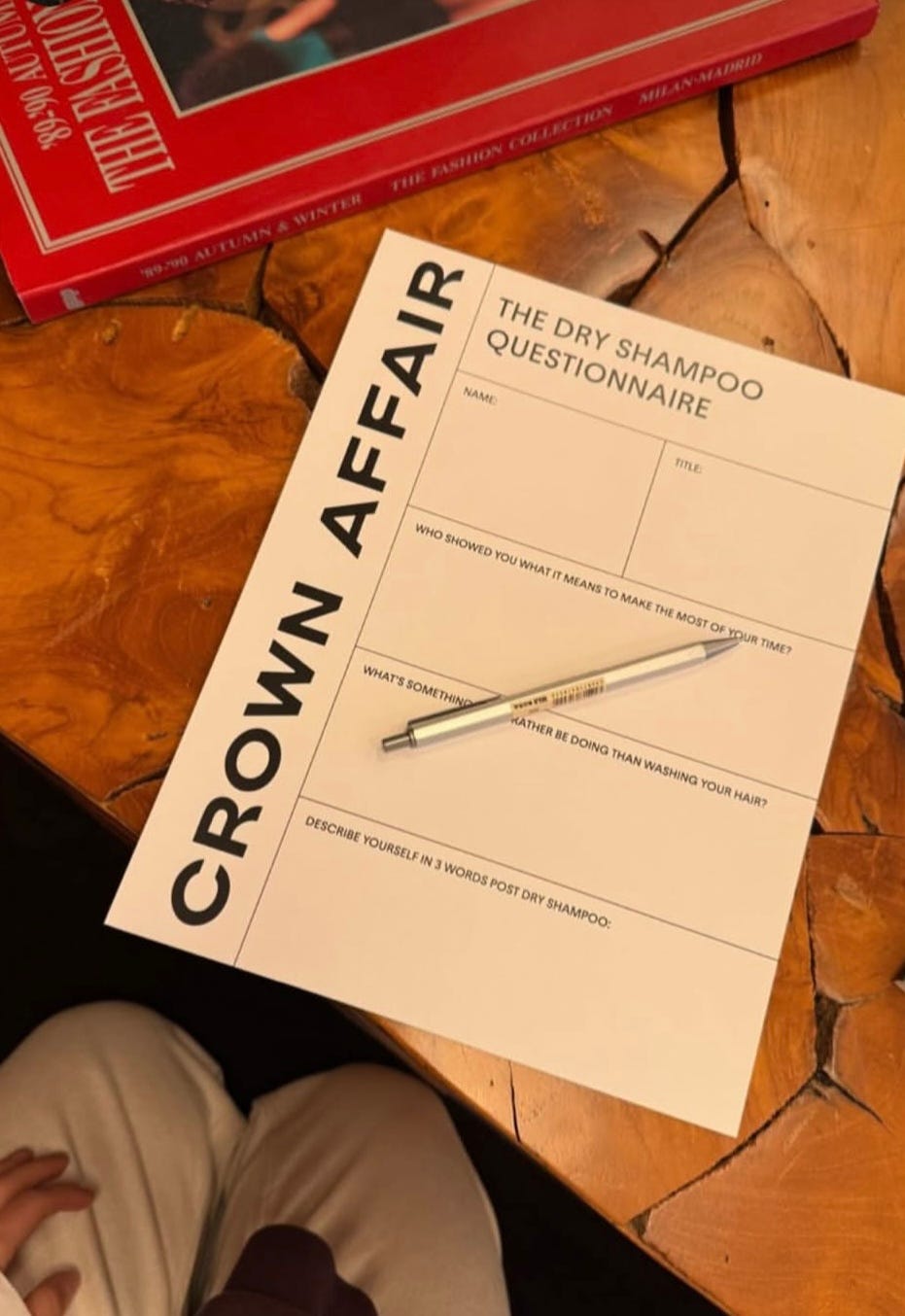
Ice-breaker inspo from “The Dry Shampoo Questionnaire” a Crown Affair event in February 2025. 1. Who showed you what it means to make the most of your time? 2. What's something you’d rather be doing than washing your hair? 3. Describe yourself in 3 words post dry shampoo. Dianna Cohen whoever put these q’s together deserves a raise because I bet you got great insights!!
How to avoid crappy answers
It’s easy to mess up an in-depth interview and miss out on the golden nuggets. Here’s what to do to avoid getting basic answers that won’t deliver impactful insights:
Be empathetic. I debated putting this in here, but it’s crucial. If you are not an empath (or someone who can cosplay an empath), someone else should be doing your research. Participants pick up on this really easily and having someone who is cold or rigid do your IDIs is a problem.
Don’t rush through the icebreaker. If your warm-up question feels like a forced chore or something to check off before getting to the real stuff, it’s not doing its job. Start by being genuine, because it sets the tone. Don’t make it feel like a corporate team-building exercise, just be a real human.
Don’t go word-for-word. It’s a discussion guide, not a customer service call center script. Yes, you have objectives to achieve with this discussion, but you need to let things flow naturally and be on the lookout for how to evolve the conversation in a way that feels seamless. When you ask questions that flow well and follow up on their previous comments without sounding robotic, participants are more likely to be engaged to give you the best response. Letting them take you off-script might get you somewhere way more valuable.
Don’t you dare cut them off. Seriously, let them finish talking. Even if you have a follow-up question that feels urgent, I promise it can wait. Jot it down, let them continue their thought(s), and then give them more time. Then, you can ask your question.
As researchers, we're basically professional conversation-havers who get paid to create the exact opposite environment of those rushed "how are you" exchanges. Whether you’re doing it through a screen or IRL, the best insights don't come from perfect questions, they come from creating moments where people forget they're being interviewed at all. Don’t skip the tea time energy!
Thanks for reading! If you have a favorite interview icebreaker that never fails to get people talking, drop it in the comments below. Or if you’re a consumer, let me know what question you’d love to be asked in research!
This is why I love ethnographies. It takes the IDI one step further by joining a person in their space. It allows you to connect on such a deeper level because you can ask about a photo or a collectible.
I LOVED this read. I was just reading another article on raising your IQ and a major call-out was "start actually listening" - being an active listener is so important, encourages us to listen to what is actually being said instead of just waiting to speak again.
In a professional setting, adding a personal, human touch, ALWAYS makes an impact.